
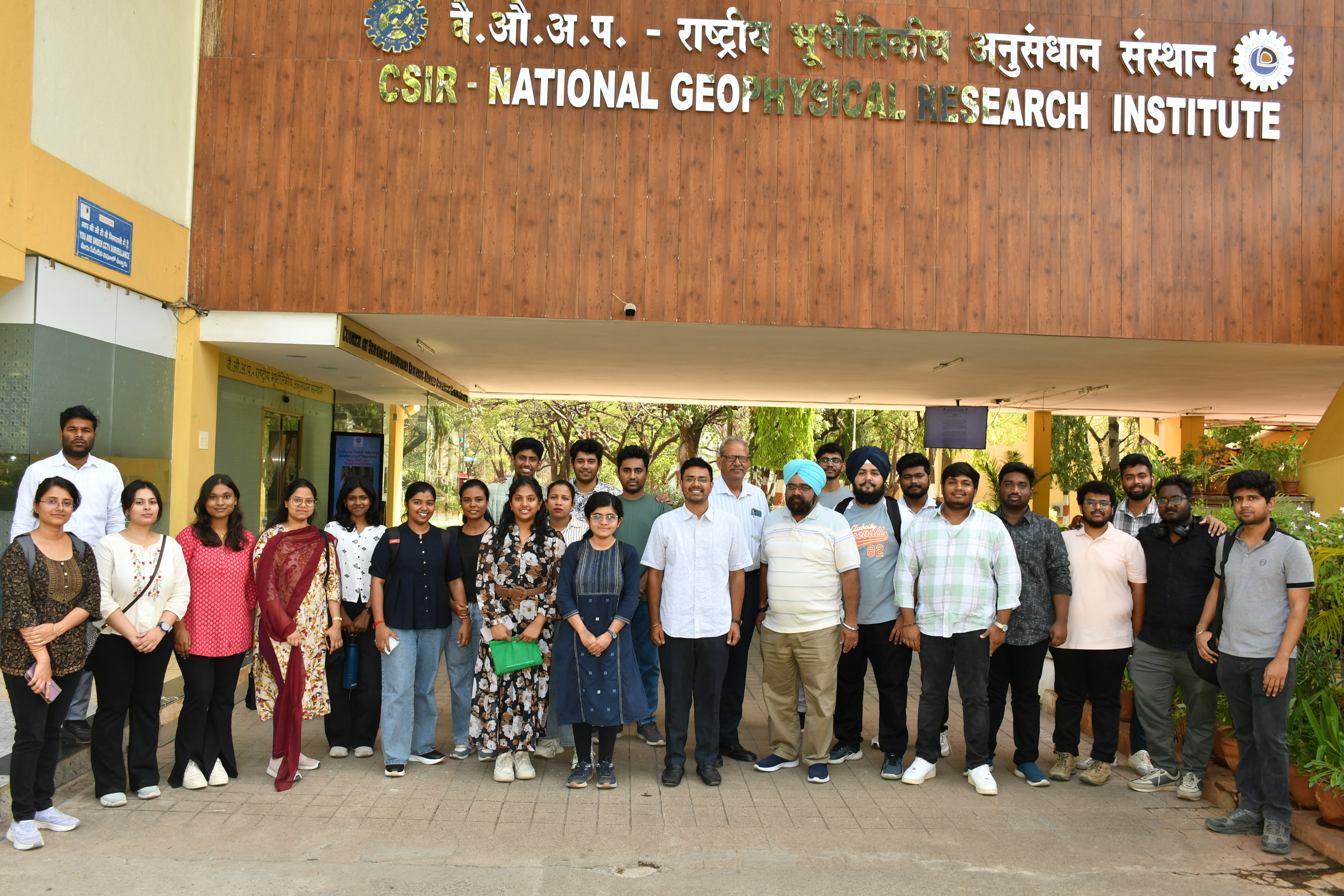
The IAStructE Student Chapter at IIIT Hyderabad organized an academic visit to the CSIR–National Geophysical Research Institute (NGRI), Hyderabad, on 8th April 2026, to provide students with direct exposure to advanced geophysical investigations and their relevance to engineering practice. The programme offered a structured platform to bridge fundamental theoretical concepts and field-scale applications in geosciences and infrastructure engineering.
The visit commenced with an introductory session by Dr. Vijay Kumar, who presented the fundamentals of earth sciences, including rock classification, mineralogy, and geological time scales. The session also outlined the institutional contributions of NGRI and highlighted the role of Nuclear Power Corporation of India Limited (NPCIL) in geotechnical and geophysical investigations. This was followed by an interaction at the Seismic Observatory led by Dr. Vijay Raghavan, where students were introduced to one of the earliest and internationally recognized seismic monitoring facilities, with emphasis on instrumentation, data acquisition, and its significance in earthquake hazard assessment.
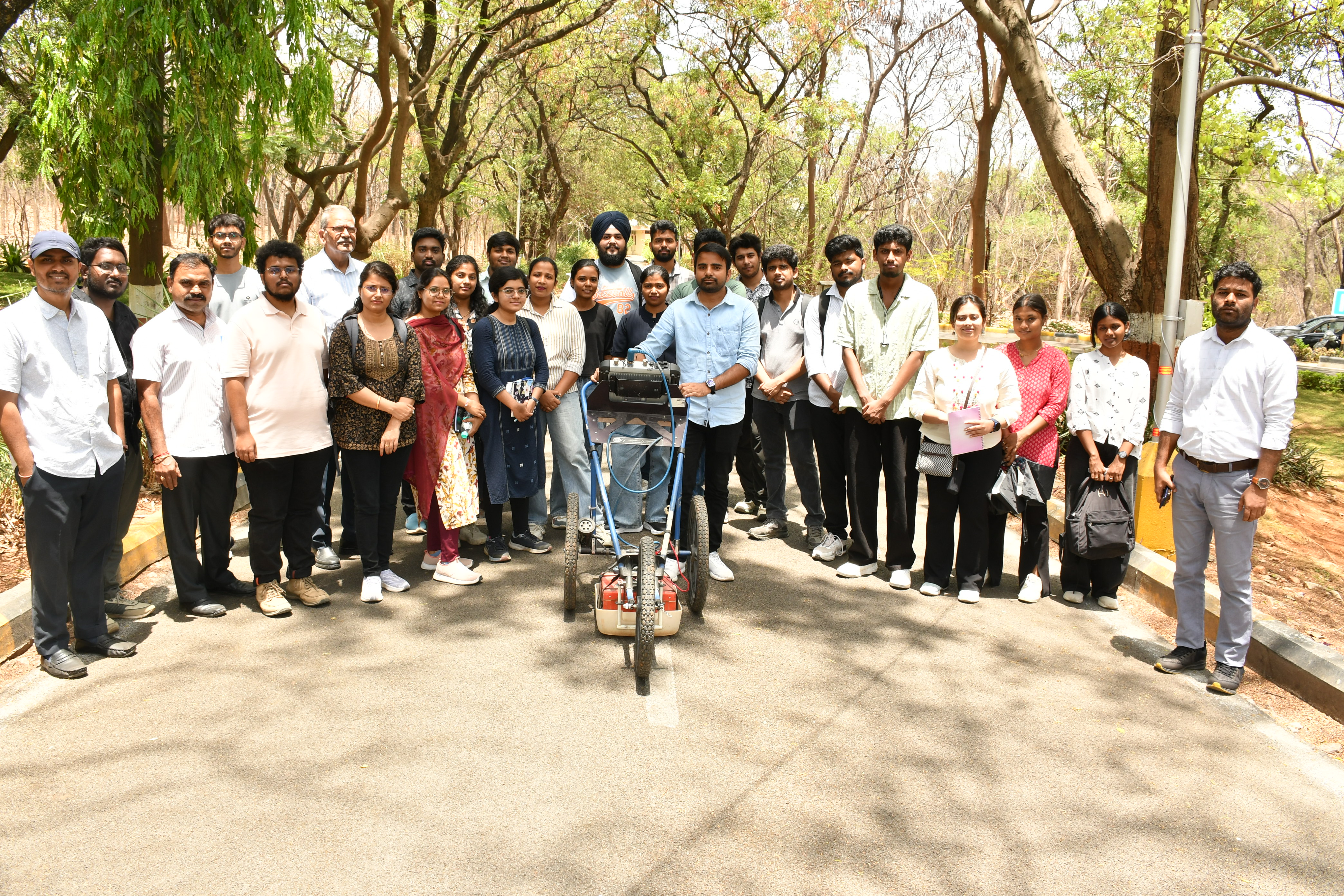
Subsequently, Dr. Bhima Raj delivered a technical session on subsurface investigation techniques, focusing on electrical resistivity and electromagnetic methods for characterizing soil and rock strata. Dr. Satish Chand Verma presented the principles and applications of Ground Penetrating Radar (GPR), particularly in the detection of subsurface anomalies such as voids, weak zones, and structural discontinuities.
The programme further included a session on rock mechanics by Dr. K. J. P. Lakshmi, with emphasis on triaxial testing and the stress–strain behaviour of geomaterials under controlled conditions. A laboratory demonstration conducted by Mr. S. Ravinder illustrated tensile strength evaluation using the Brazilian (indirect tensile) test on a Universal Testing Machine (UTM). Students also visited the Gravity Observatory, where advanced instrumentation, including LaCoste & Romberg gravimeters, CG gravimeters, and Absolute Gravimeters, was demonstrated, highlighting their role in geodetic and subsurface density investigations.
The concluding sessions included a detailed presentation by Dr. Satyendra Singh on controlled-source seismic methods and gas hydrate exploration, followed by Dr. Laxmi Narayana discussing Controlled Source Seismology (CSS) and its applications in deep subsurface imaging.
Overall, the visit constituted a technically enriching experience, enabling students to gain comprehensive insights into state-of-the-art geophysical techniques and their interdisciplinary applications in civil and structural engineering domains.
Visitors Count