
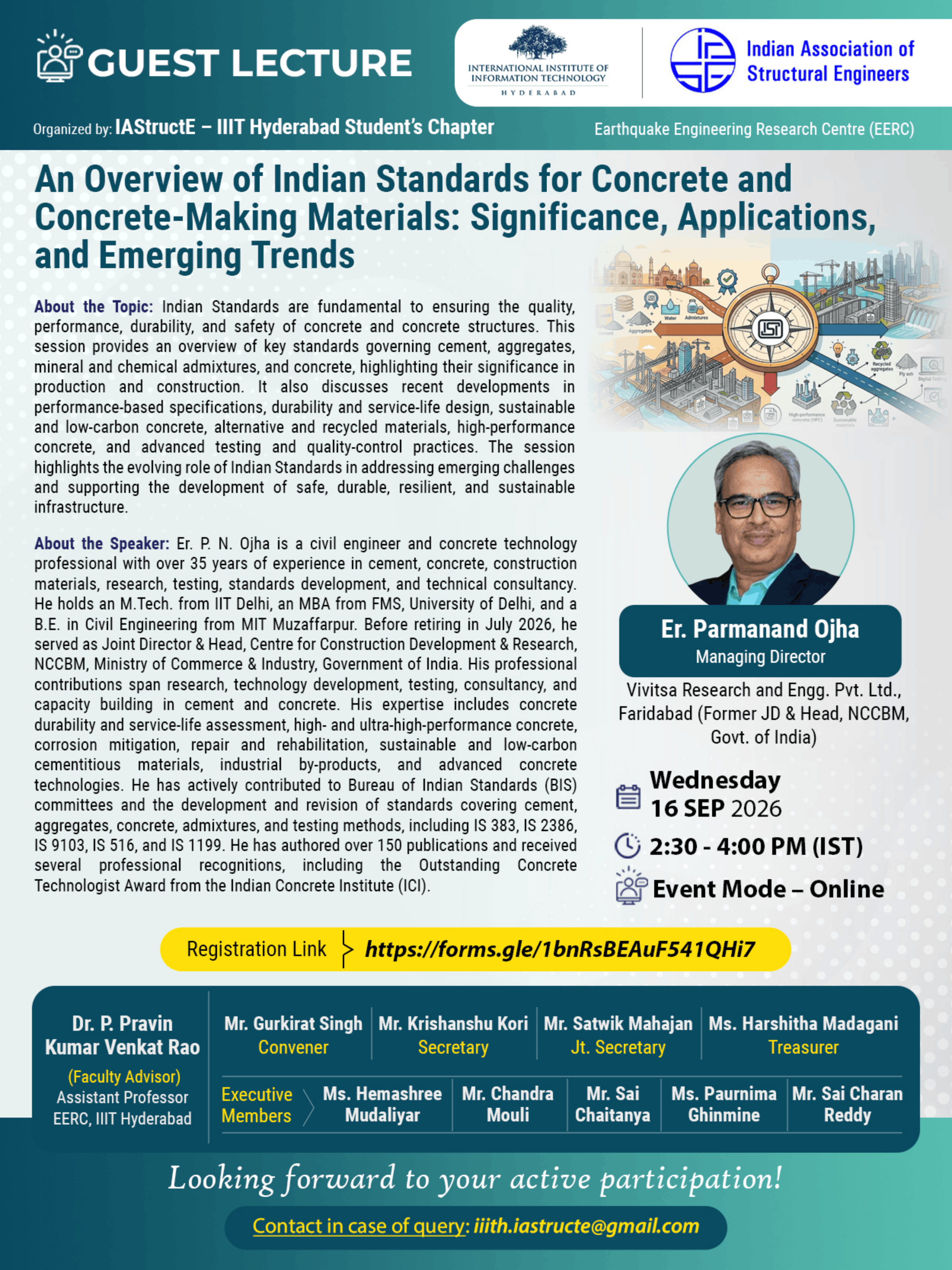
The durability of concrete is a critical factor governing the resilience, performance, and service life of structures. Recognizing the importance of understanding the relationship between concrete materials, durability, and applicable standards, the IAStructE–IIIT Hyderabad Student Chapter of the Earthquake Engineering Research Centre (EERC), organized a guest lecture on 16th September 2026 titled “An Overview of Indian Standards for Concrete and Concrete-Making Materials: Significance, Applications, and Emerging Trends”.
The lecture was delivered by Er. Paramanad Ojha, Managing Director, Vivitsa Research and Engineering Pvt. Ltd., and former Joint Director & Head, National Council for Cement and Building Materials (NCCBM), Government of India. Drawing upon his extensive professional experience in concrete technology, standards development, research, testing, and consultancy, Er. Ojha provided valuable insights into the evolving role of Indian Standards in contemporary construction practices.
The lecture covered key Indian Standards on cement, aggregates, concrete, mineral and chemical admixtures, and concrete testing. Particular emphasis was placed on the evolution of IS 456:2026 (Draft Version) and the emerging transition towards performance-based and service-life-oriented approaches to durability. The discussion addressed critical durability-related challenges, including early-age cracking, reinforcement corrosion, and concrete spalling, while highlighting the increasing importance of effective quality assurance and quality control practices.
The session also explored several emerging developments in concrete technology, including low-carbon concrete, recycled and sustainable materials, geopolymer concrete, Ultra-High-Performance Concrete (UHPC), and 3D-printable concrete. The speaker emphasised the importance of sustained research and development in addressing existing knowledge gaps, advancing sustainable construction practices, and facilitating the incorporation of innovative materials and technologies into future standards.
The lecture provided participants with a comprehensive understanding of how evolving standards, advances in material technology, durability considerations, and structural performance collectively contribute to the development of safe, durable, resilient, and sustainable infrastructure. The session was highly informative and offered valuable perspectives to students and professionals seeking to understand the current developments and future directions in concrete technology and structural engineering.
Visitors Count